

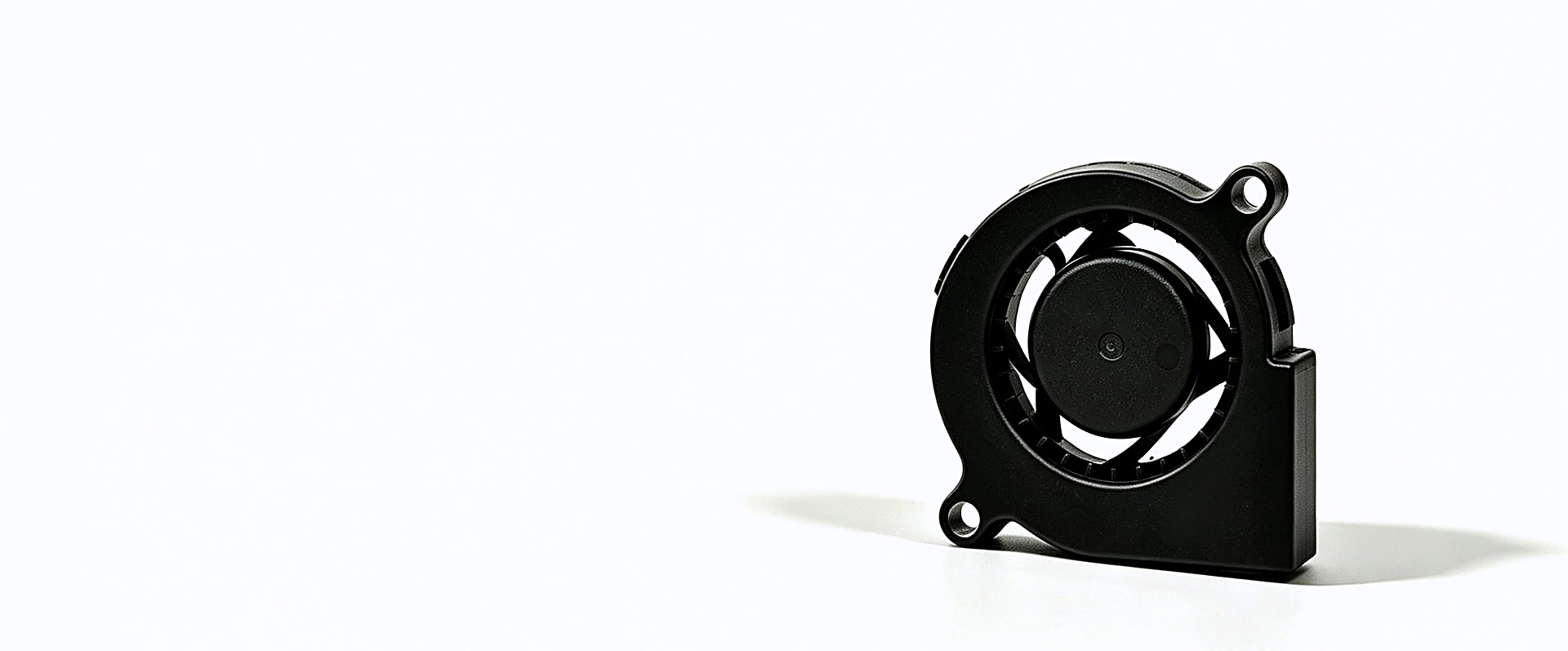
Military Centrifugal Blowers & Radial Cooling Fans
Constant static pressure through ducts, filters, and dense electronics where axial fans stall.
Perseus centrifugal blowers hold static pressure where axial fans stall. The radial impeller keeps pressure output near-constant as system resistance rises, so airflow still reaches heat sources behind multi-bend radar ducts, restricted console layouts, and deep electro-optic housings. Prometheus and Atlas cover 50mm to 150mm frames.
Constant static pressure through ducts, filters, and dense electronics where axial fans stall.
Perseus centrifugal blowers hold static pressure where axial fans stall. The radial impeller keeps pressure output near-constant as system resistance rises, so airflow still reaches heat sources behind multi-bend radar ducts, restricted console layouts, and deep electro-optic housings. Prometheus and Atlas cover 50mm to 150mm frames.
Core Technical Features
Radial Impeller Geometry:
Impeller and volute geometry is tuned to hold static pressure as system resistance rises — the operating region where axial fans lose airflow fastest.
Stable Pressure in Constrained Layouts:
Delivers directed airflow to specific heat sources inside densely packed enclosures, where the flow path narrows or turns before reaching the component.
Ruggedized Housing:
Housings and bearings are built to withstand mechanical shock and vibration per MIL-STD-810 standards, with material configuration set per variant.
Compact Frame Range:
50mm to 150mm frames fit airborne radar modules, shipboard console displays, and VPX or CPCI chassis with limited mounting depth.
Typical Applications
-
![High-Resistance Ducted Airflow Systems]()
Radar cooling ducts with multiple bends and long runs create impedance that cuts axial fan output. Prometheus and Atlas hold static pressure through those paths.
High-Resistance Ducted Airflow Systems
-
![Shipboard Console Display Cooling]()
Naval consoles pack electronics into shallow housings with restricted internal paths. The compact Prometheus series fits the depth limit while preventing processor throttling.
Shipboard Console Display Cooling
-
![Electro-Optic System Thermal Control]()
EO/IR enclosures hold imaging sensors and signal processors that must stay cool without disturbing adjacent optical paths. IP68 centrifugal configurations meet both thermal and sealing needs.
Electro-Optic System Thermal Control
-
![Rugged VPX / CPCI Chassis Cooling]()
Multi-slot VPX and CPCI chassis create tortuous airflow paths across cards, power supplies, and interconnects. Sustained static pressure is what keeps every module inside its thermal limit.
Rugged VPX / CPCI Chassis Cooling


Series Selection Guide
Two series cover 50 mm to 150 mm with no gaps — place a model by its outer frame size: ≤110 mm Prometheus, ≥111 mm Atlas.
| Series | Frame Size | Max Airflow (CFM) | Power Range (W) |
|---|---|---|---|
| Prometheus | ≤ 110 mm | 45.96 | 1.35–18.24 |
| Atlas | ≥ 111 mm | 150.93 | 8.40–25.44 |
Compare Models
Narrow by frame size and supply voltage, then click any model to open its full technical page.
| Model | Frame | Airflow CFM | Static pres. mmH2O | Voltage | Noise dB(A) |
|---|
All Centrifugal Fan Models
7 models
- Prometheus PCG36FLW16-10G-AA 50 mm x 50 mm x 10.5 mm 5 V DC 3.35 CFM
- Prometheus PCG36FLW36-10G-AA 50 mm x 50 mm x 10.5 mm 12 V DC 3.35 CFM
- Prometheus PCG70FLW59-20G-AB Dia. 70 mm x 20 mm 28 V DC 42.8 CFM
- Prometheus PCG54FLW57-20G 76 mm x 70 mm x 20 mm 28 V DC 12.71 CFM
- Prometheus PCG100FLW54-25G-AA 100 mm x 100 mm x 25 mm 28 V DC 45.96 CFM
- Atlas PCG72FLW54-40G-AB 120 mm x 99 mm x 40 mm 28 V DC 29 CFM
- Atlas PCG72FLW56-40G-AA 120.7 mm x 120.7 mm x 40.6 mm 28 V DC 45 CFM
Model Reference
Below are representative models — one per series — illustrating key performance parameters and environmental adaptabilities. Each PQ curve shows measured static pressure vs. airflow at rated voltage.


Core Electrical & Performance Parameters
| Parameter | Specification |
|---|---|
| Rated Voltage | 12V DC |
| Voltage Range | 10-13.5V DC |
| Rated Rotational Speed | 6,000 RPM |
| Max Airflow | 3.35 CFM |
| Max Static Pressure | 14.16 mmH2O |
| Acoustic Noise | 37.1 dB(A) |
| Speed Control Mode | PWM |
Mechanical & Environmental Parameters
| Parameter | Specification |
|---|---|
| Frame Size | 50mm x 50mm x 10.5mm |
| Protection Rating | IP68 configuration option |
| Operating Temperature Range | -55°C to +85°C |
P-Q Curve — PCG36FLW36-10G-AA @ 12V DC
At nominal input conditions, this reference curve maps static pressure from 0-14.1 mmH2O against airflow from 0-3.3 CFM. Use it for first-pass operating-point review; full-resolution P-Q curves, CAD files, and product-specific datasheets are available for qualified RFQ review.

Core Electrical & Performance Parameters
| Parameter | Specification |
|---|---|
| Rated Voltage | 28V DC |
| Voltage Range | 18-32V DC |
| Rated Rotational Speed | 4,100 RPM |
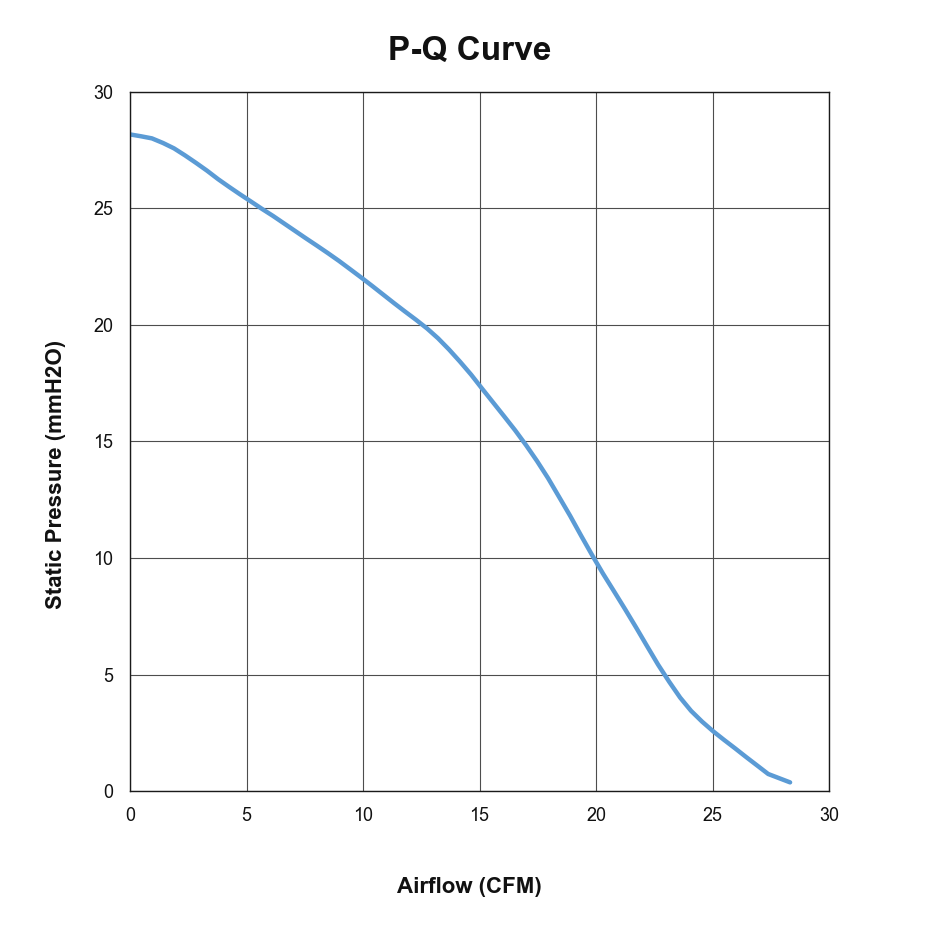
| Max Airflow | 29 CFM |
| Max Static Pressure | 25.4 mmH2O |
| Acoustic Noise | 41 dB(A) |
| Speed Control Mode | PWM |
Mechanical & Environmental Parameters
| Parameter | Specification |
|---|---|
| Frame Size | 120mm x 99mm x 40mm |
| Protection Rating | IP55 configuration option |
| Operating Temperature Range | -55°C to +85°C |
P-Q Curve — PCG72FLW54-40G-AB @ 28V DC
At nominal input conditions, this reference curve maps static pressure from 0-28.2 mmH2O against airflow from 0-28.3 CFM. Use it for first-pass operating-point review; full-resolution P-Q curves, CAD files, and product-specific datasheets are available for qualified RFQ review.
High Static Pressure Fans for Dense Electronics Enclosures
Perseus centrifugal blowers and high static pressure fan assemblies are designed for electronics enclosures where airflow must pass through filters, ducts, heat exchangers, compact PCB layouts, or high-impedance chassis structures. In these installations, a fan with lower free-air CFM can outperform a higher-CFM axial fan when its pressure capability better matches the system impedance curve.
Typical applications include VPX chassis thermal management, avionics cooling, radar electronics, UAV payload bays, and shipboard control cabinets requiring stable airflow under restricted inlet and outlet conditions. Because the fan operates where its P-Q curve crosses the system impedance curve, selection should be validated at the installed operating point rather than at free-air conditions.
Centrifugal units are typically reviewed where the airflow path presents higher system resistance than an open axial installation, or where the flow must turn before reaching the heat source.
Centrifugal Fan / Blower Selection FAQ
Guidance for engineers deciding when a blower is the right call and how to spec high-static-pressure centrifugal fans.
When should I choose a centrifugal fan (blower) over an axial fan?
Choose a blower when your system has real flow resistance — ducts, inlet/outlet filters, dense card stacks, or long airflow paths. Centrifugal designs develop high static pressure at moderate air volumes; axial fans move high airflow but collapse quickly as back pressure rises.
How much static pressure does my enclosure actually need?
Your fan operates where its P-Q curve crosses the system impedance curve. Measure or estimate the pressure drop of filters, ducting, and baffles at your target airflow — if the requirement is high, pick a blower whose curve still delivers airflow at that pressure instead of over-sizing an axial fan.
Can I get a high-reliability blower for harsh defense and aerospace environments?
Yes — blowers are available with sealed or dual ball bearings, wide -55°C to +85°C operating ranges, and altitude-corrected performance. Confirm cold-start reliability and that the rated static pressure and airflow are derated for your altitude before you commit.
What data should I send for a high-static or filter-heavy build?
Provide required airflow, target static pressure, supply voltage, mounting dimensions, ambient range, and operating altitude. If pressure drop is uncertain, share the duct or filter details so the operating point can be reviewed against a real P-Q curve.
Engineering Resources
Technical guides to support your fan selection and system integration.
How to Read P-Q Curves for Military Fan Selection
Understand static pressure, airflow operating points, and system impedance for defense cooling applications.
Military Cooling Fan Selection Guide
Selection criteria for military cooling fans including environmental standards and qualification requirements.
28VDC Avionics Cooling Fan Evaluation
Evaluation framework for 28VDC avionics fans covering startup current, airflow, and EMI considerations.
Technical Insights
Engineering insights on thermal management, fan selection, and defense electronics cooling.