

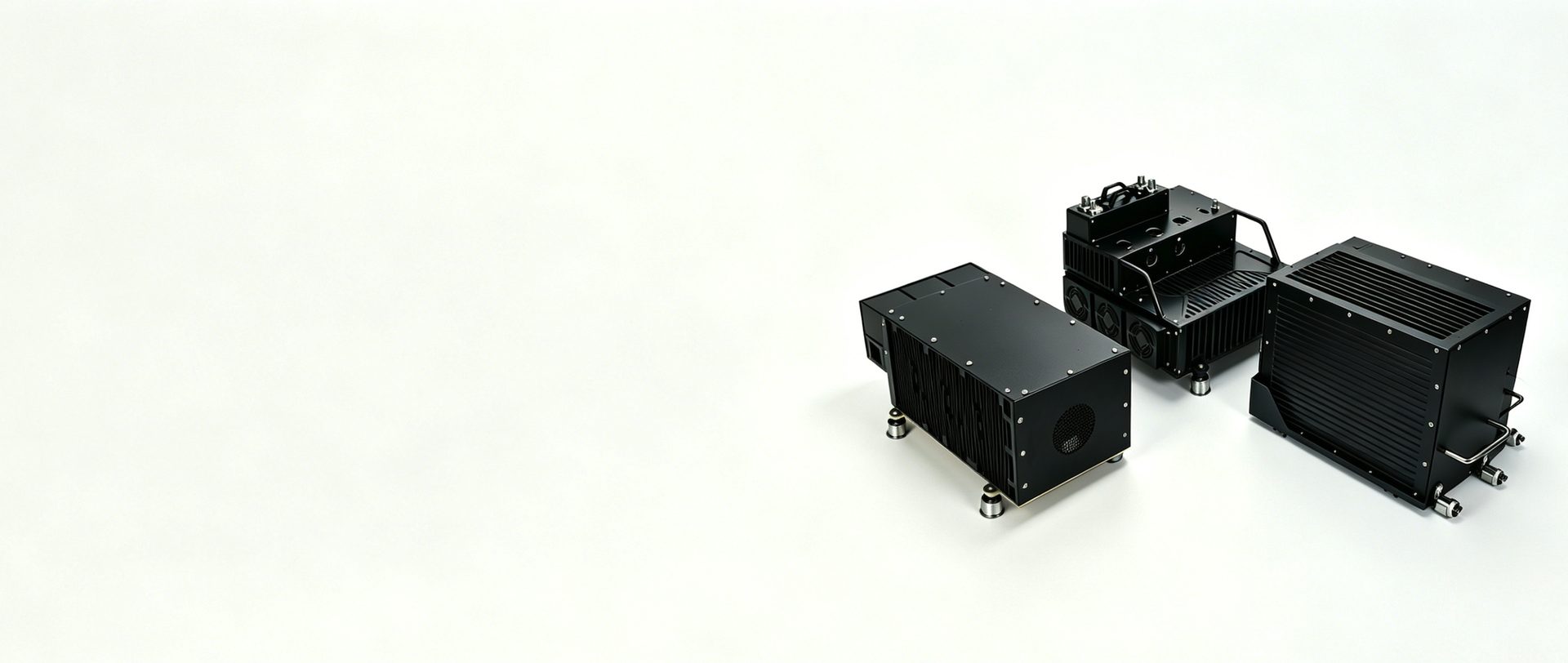
Integrated Thermal Management Systems for Defense Electronics
Air-Cooled Chassis, Liquid Cold Plates, and Phase-Change Thermal Hardware
Perseus designs integrated thermal management systems for defense electronics operating in airborne, naval, ground, and high-reliability environments. Architecture options include fan-assisted air-cooled enclosures up to 2,000 W per chassis, liquid-cooled systems managing heat flux density up to 200 W/cm² at the module interface, and passive thermal hardware such as heat pipes and phase-change cold plates for transient heat loads.
Air-Cooled Chassis, Liquid Cold Plates, and Phase-Change Thermal Hardware
Perseus designs integrated thermal management systems for defense electronics operating in airborne, naval, ground, and high-reliability environments. Architecture options include fan-assisted air-cooled enclosures up to 2,000 W per chassis, liquid-cooled systems managing heat flux density up to 200 W/cm² at the module interface, and passive thermal hardware such as heat pipes and phase-change cold plates for transient heat loads.
Core Technical Features
Integrated Fan and Chassis Ecosystem:
Perseus can coordinate airflow source, enclosure architecture, and system impedance to reduce interface risk in thermal design reviews.
High-Capacity Heat Dissipation:
Air-cooled enclosures can support up to 2,000 W per chassis, while liquid-cooled architectures can support up to 200 W/cm² at the module interface by configuration.
Liquid Cold Plate Integrity:
Vacuum-brazed and friction-stir-welded cold plate concepts can be reviewed for PAO, EGW, or Jet-A compatible cooling loops.
Passive and Transient Thermal Control:
Heat pipe assemblies and phase-change material cold plates help manage short-duration thermal spikes when steady-state airflow alone is not sufficient.
Typical Applications
-
![Airborne Mission Computers and Radar Systems]()
Supports fan-assisted or conduction-cooled chassis for avionics, radar processors, and mission computers where SWaP and qualification schedules must be balanced.
Airborne Mission Computers and Radar Systems
-
![Shipboard Electronics Cabinets]()
Applies to naval consoles, radar cabinets, and communication electronics that require controlled cooling and corrosion-aware mechanical design.
Shipboard Electronics Cabinets
-
![Ground Mobile Command and Control]()
Supports rugged shelter and vehicle electronics where enclosure impedance, dust exposure, and maintainability affect the thermal architecture.
Ground Mobile Command and Control
-
![Compact Payload and Guidance Electronics]()
Uses conduction paths, cold plates, heat pipes, or phase-change hardware where airflow space is limited and transient heat loads are high.
Compact Payload and Guidance Electronics


Series Selection Guide
Series 1: Air-Cooled Chassis
| Configuration | Slot Count | Module Standard | Thermal Capacity | Cooling Method | Weight | Dimensions | Operating Temp |
|---|---|---|---|---|---|---|---|
| 1/2 ATR Air-Cooled | 3U modules | VPX / CPCI / ASAAC | Up to 800 W | Aerospace fans | ~13.5 kg | 315 x 194 x 124 mm | By configuration |
| 1 ATR Air-Cooled | 3U modules | VPX / CPCI / ASAAC | Up to 2,000 W | Aerospace fans | ~27.5 kg | 315 x 194 x 256 mm | By configuration |
| 4 MCU Air-Cooled | 3U / 6U modules | VPX / custom | Up to 1,000 W | Centrifugal fans | Custom | Custom | By configuration |
| VPX Air-Cooled | 8 x 6U VPX | VITA 46 / 48 | Up to 1,000 W | Axial fans | Custom | Custom | By configuration |
Series 2: Conduction-Cooled Chassis
| Configuration | Slot Count | Module Standard | Thermal Capacity | Heat Sink Type | Weight | Dimensions | Operating Temp |
|---|---|---|---|---|---|---|---|
| 1/2 ATR Conduction | 3U modules | VPX / CPCI / ASAAC | Up to 800 W | Machined aluminum | ~13.5 kg | 315 x 194 x 124 mm | -55°C to +85°C |
| 4 MCU Conduction | 3U / 6U modules | VPX / custom | Custom | Finned heat sink | Custom | Custom | -55°C to +85°C |
| Custom ATR Conduction | Variable | ASAAC / custom | Up to 800 W | Cold plate / conduction path | Custom | Custom | -55°C to +85°C |
Series 3: Liquid-Cooled Chassis
| Configuration | Slot Count | Module Standard | Heat Flux Density | Cold Plate Type | Weight | Dimensions | Operating Temp |
|---|---|---|---|---|---|---|---|
| 4U Liquid-Cooled Rack | VPX modules | VITA 48 | 50-200 W/cm² | Blind-mate connectors | Custom | 4U rack height | By configuration |
| Airborne Liquid-Cooled | Variable | VPX / custom | 50-200 W/cm² | Serpentine flow path | Custom | Custom | By configuration |
| RF Liquid-Cooled | High-power RF | Custom | Up to 200 W/cm² | Microchannel option | Custom | Custom | By configuration |
Integrated Thermal Management Modules for Defense Electronics
Perseus integrated thermal management modules combine high-performance cooling fans, optimized heat exchangers, air filtration, and mounting provisions into pre-engineered assemblies for defense electronics systems. These modules provide validated thermal performance in ruggedized packages designed for radar enclosures, avionics bays, vehicle electronics compartments, and shipboard cabinets requiring reliable forced-air cooling.
Thermal modules are engineered for operating conditions from -55°C to +85°C with environmental qualification planning available per MIL-STD-810H for shock, vibration, humidity, salt fog, and temperature cycling. Integrated designs include fan speed control options, tachometer feedback, fault detection, and EMI filtering compatible with military power systems (28VDC, 115VAC 400Hz). Module configurations can be tailored to specific thermal loads, airflow requirements, and available envelope constraints.
Integrated thermal modules should be selected based on total heat dissipation, maximum allowable component temperature, available airflow path, and environmental conditions. Pre-engineered modules reduce integration risk compared to discrete fan and heat sink assemblies because airflow impedance and thermal performance are characterized as a complete system.
When specifying thermal modules, include derating for high-altitude operation, filter clogging over the maintenance interval, and worst-case component power dissipation. Maintaining adequate margin ensures reliable cooling performance throughout equipment service life under field conditions.
Engineering Resources
Technical guides to support your fan selection and system integration.
How to Read P-Q Curves for Military Fan Selection
Understand static pressure, airflow operating points, and system impedance for defense cooling applications.
Military Cooling Fan Selection Guide
Selection criteria for military cooling fans including environmental standards and qualification requirements.
28VDC Avionics Cooling Fan Evaluation
Evaluation framework for 28VDC avionics fans covering startup current, airflow, and EMI considerations.
Technical Insights
Engineering insights on thermal management, fan selection, and defense electronics cooling.