

Military-Grade Avionics Cooling Fans & Small DC Fans
High-static-pressure DC fans for avionics, missile guidance, and space-constrained chassis.
Perseus small DC fans are built for assemblies where clearance and weight are already committed. Blade geometry is tuned for high-impedance heat sinks and narrow ducts, so airflow holds up behind filters and dense fin stacks. Minipro, Superpro, and Ultrapro cover 30mm to 80mm frames on 5–48V DC.
High-static-pressure DC fans for avionics, missile guidance, and space-constrained chassis.
Perseus small DC fans are built for assemblies where clearance and weight are already committed. Blade geometry is tuned for high-impedance heat sinks and narrow ducts, so airflow holds up behind filters and dense fin stacks. Minipro, Superpro, and Ultrapro cover 30mm to 80mm frames on 5–48V DC.
Core Technical Features
High-Static-Pressure Blade Geometry:
Profiles tuned for sealed enclosures and dense fin stacks, where fin resistance shifts as filters load up.
MIL-STD-810H Shock & Vibration:
Qualification planning references Method 516.8 for 40g shock (11ms, three-axis) and Method 514.8 for vibration endurance. Preloaded bearings hold rotational integrity through launch and high-G maneuvers.
-55°C to +85°C Operating Range:
Wide-temperature operation with cold-start review where the program requires it. References Methods 501.7 and 502.7; altitude derating reviewed against the platform profile.
SWaP-Optimized Frame Sizes:
5–48V DC input, frames from 30mm, with IP68 ingress protection per MIL-STD-810H Method 512.6. Light enough for UAV sensor payloads and missile guidance bays.
Typical Applications
-
![Airborne Radar Thermal
Management]()
Dense fin arrays in UAV and tactical aircraft radar modules exceed what standard axial fans can push through. Minipro and Superpro hold static pressure where it matters.
Airborne Radar Thermal
Management
-
![Electro-Optic Targeting
Systems]()
Sealed EO/IR housings concentrate heat in small, vibration-exposed volumes. IP68 configurations handle thermal load and ingress protection together.
Electro-Optic Targeting
Systems
-
![Missile Guidance and Control
Electronics]()
Guidance modules under 40mm need cooling that survives launch acceleration. The Minipro's MIL-STD-810H shock rating and IP68 sealing keep airflow active through terminal phase maneuvers.
Missile Guidance and Control
Electronics
-
![Shipboard Communication
Cabinets]()
Salt fog, humidity, and continuous low-frequency vibration. Qualification planning references 96-hour neutral and 192-hour acidic salt spray for long service intervals.
Shipboard Communication
Cabinets


Series Selection Guide
Three series cover 30 mm to 90 mm frames with no gaps — place a model by its outer frame size: ≤50 mm Minipro, 51–70 mm Superpro, 71–91 mm Ultrapro.
| Series | Frame Size | Max Airflow (CFM) | Power Range (W) |
|---|---|---|---|
| Minipro | ≤ 50 mm | 38.60 | 0.70–27.20 |
| Superpro | 51–70 mm | 68.39 | 2.04–30.80 |
| Ultrapro | 71–91 mm | 145.83 | 1.92–106.40 |
Compare Models
Narrow by frame size and supply voltage, then click any model to open its full technical page.
| Model | Frame | Airflow CFM | Static pres. mmH2O | Voltage | Noise dB(A) |
|---|
All Small DC Fan Models
10 models
- Minipro PCG27FZW39-10G-AA 30 mm x 30 mm x 10 mm 12 V DC 4.82 CFM
- Minipro PCG36FZW528-30G-AA Dia. 44.45 mm x 39.2 mm 28 V DC 20.5 CFM
- Minipro PCG44FZW37-20G-AA 50 mm x 50 mm x 20 mm 12 V DC 16 CFM
- Superpro PCG50FZW522-47G-AB Dia. 55.3 mm x 47 mm 28 V DC 44.48 CFM
- Superpro PCG54FZW412-32G-AA 60 mm x 60 mm x 32 mm 24 V DC 61.4 CFM
- Superpro PCG54FZW512-32G-EA 60 mm x 60 mm x 32 mm 28 V DC 61.4 CFM
- Ultrapro PCG74FZW76-38G-AK 79.2 mm x 79.2 mm x 38.1 mm 48 V DC 68.07 CFM
- Ultrapro PCG74FZW415-38G-AC 80 mm x 80 mm x 38 mm 24 V DC 121.1 CFM
- Ultrapro PCG74FZW515-38G-AC 80 mm x 80 mm x 38 mm 28 V DC 121.1 CFM
- Ultrapro PCG70FZW522-40G-BC Dia. 82.6 mm x 40.5 mm 28 V DC 105.8 CFM
Model Reference
Below are representative models — one per series — illustrating key performance parameters and environmental adaptabilities. Each PQ curve shows measured static pressure vs. airflow at rated voltage.


Core Electrical & Performance Parameters
| Parameter | Specification |
|---|---|
| Rated Voltage | 12V DC |
| Voltage Range | 10-13.5V DC |
| Operating Current (Free Air) | 0.06A |
| Rated Power (Free Air) | 0.72W |
| Rated Rotational Speed | 9,800 RPM +/-15% |
| Max Airflow | 4.82 CFM / 8.18 m3/h |
| Max Static Pressure | 3.16 mmH2O / 30.96 Pa |
| Acoustic Noise | 26.3 dB(A), Max 27.2 dB(A) |
| Speed Control Mode | N/A |
| Output Signal | N/A |
| Rotation Direction | Counterclockwise, viewed from impeller side |
Mechanical & Environmental Parameters
| Parameter | Specification |
|---|---|
| Frame Size | 30mm x 30mm x 10mm |
| Frame / Impeller Material | Engineering-polymer configuration; final material by selected variant |
| Bearing Type | Dual ball bearing |
| Weight | 11g |
| Protection Rating | IP68 configuration option |
| Lead Interface | AWG26 power leads; signal leads optional by configuration |
| Insulation Resistance | ≥10MOhm at 500V DC, frame-to-lead |
| Dielectric Withstand | <1mA at 500V DC, frame-to-lead |
| L10 Life | ≥50,000h at 40C, 15-65% RH |
| Operating Temperature Range | -55°C to +85°C |
| Storage Temperature Range | -55°C to +85°C |
| Salt Fog Exposure | 96h neutral salt spray profile |
| Humidity Exposure | 95% +/-5% RH, 10 cycles of 24h |
| Rain Exposure | Intensified rain exposure, 40min per side |
| Sand & Dust Exposure | Dust and sand blowing exposure profile |
| Low Pressure / Altitude | Altitude profile listed in source test requirements; final method by program plan |
| Mechanical Shock | 30g peak, 11ms sawtooth, 18 total shocks |
| Acceleration | 9g performance / 13.5g structural profile |
| Temperature Shock | -55°C to +85°C, transfer time <1min, 3 cycles |
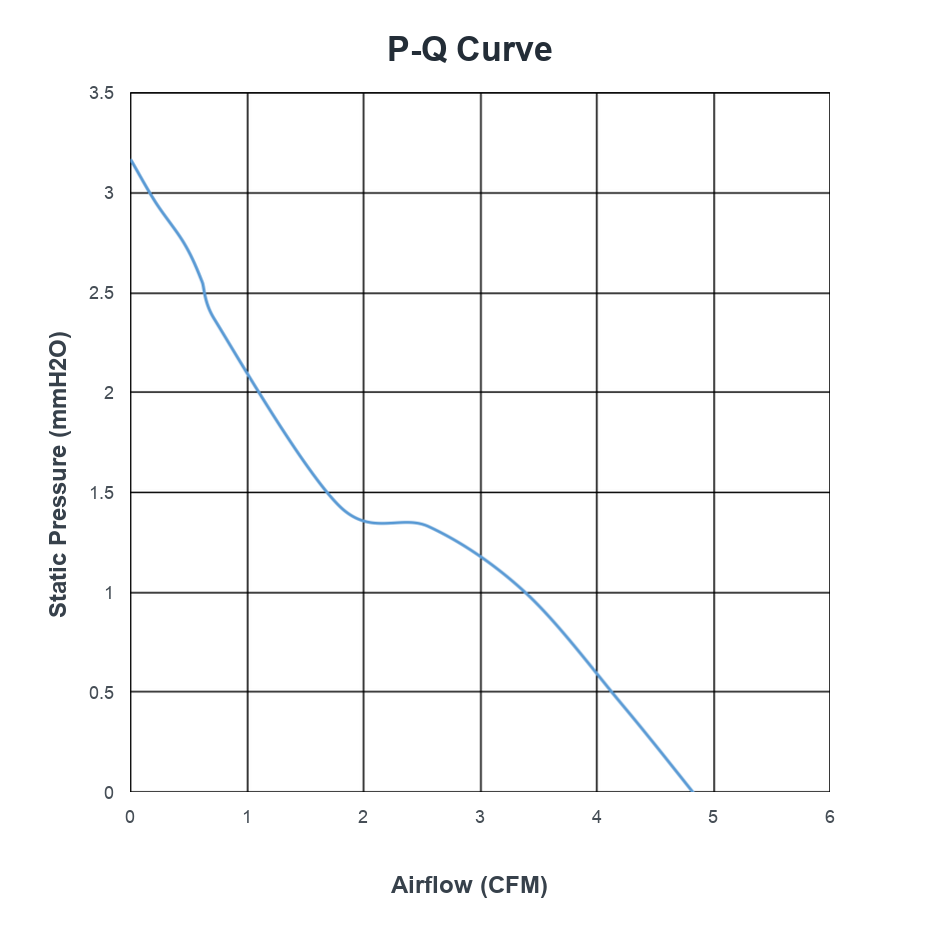
P-Q Curve — PCG27FZW39-10G-AA @ 12V DC
At nominal input conditions, this reference curve maps static pressure from 0-3.16 mmH2O against airflow from 0-4.82 CFM. Use it for first-pass operating-point review; full-resolution P-Q curves, CAD files, and product-specific datasheets are available for qualified RFQ review.

Core Electrical & Performance Parameters
| Parameter | Specification |
|---|---|
| Rated Voltage | 28V DC |
| Voltage Range | 18-32V DC |
| Rated Rotational Speed | 20,000 RPM |
| Max Airflow | 44.48 CFM |
| Max Static Pressure | 67.97 mmH2O |
| Acoustic Noise | 75 dB(A) |
Mechanical & Environmental Parameters
| Parameter | Specification |
|---|---|
| Frame Size | Dia. 55.3mm x 47mm |
| Protection Rating | IP68 configuration option |
| Operating Temperature Range | -55°C to +85°C |
P-Q Curve — PCG50FZW522-47G-AB @ 28V DC
At nominal input conditions, this reference curve maps static pressure from 0-73.5 mmH2O against airflow from 0-49.4 CFM. Use it for first-pass operating-point review; full-resolution P-Q curves, CAD files, and product-specific datasheets are available for qualified RFQ review.

Core Electrical & Performance Parameters
| Parameter | Specification |
|---|---|
| Rated Voltage | 48V DC |
| Voltage Range | 36-55V DC |
| Rated Rotational Speed | 6,300 RPM |
| Max Airflow | 68.07 CFM |
| Max Static Pressure | 19.37 mmH2O |
| Acoustic Noise | 63.5 dB(A) |
Mechanical & Environmental Parameters
| Parameter | Specification |
|---|---|
| Frame Size | 79.2mm x 79.2mm x 38.1mm |
| Protection Rating | IP67 configuration option |
| Operating Temperature Range | -55°C to +85°C |
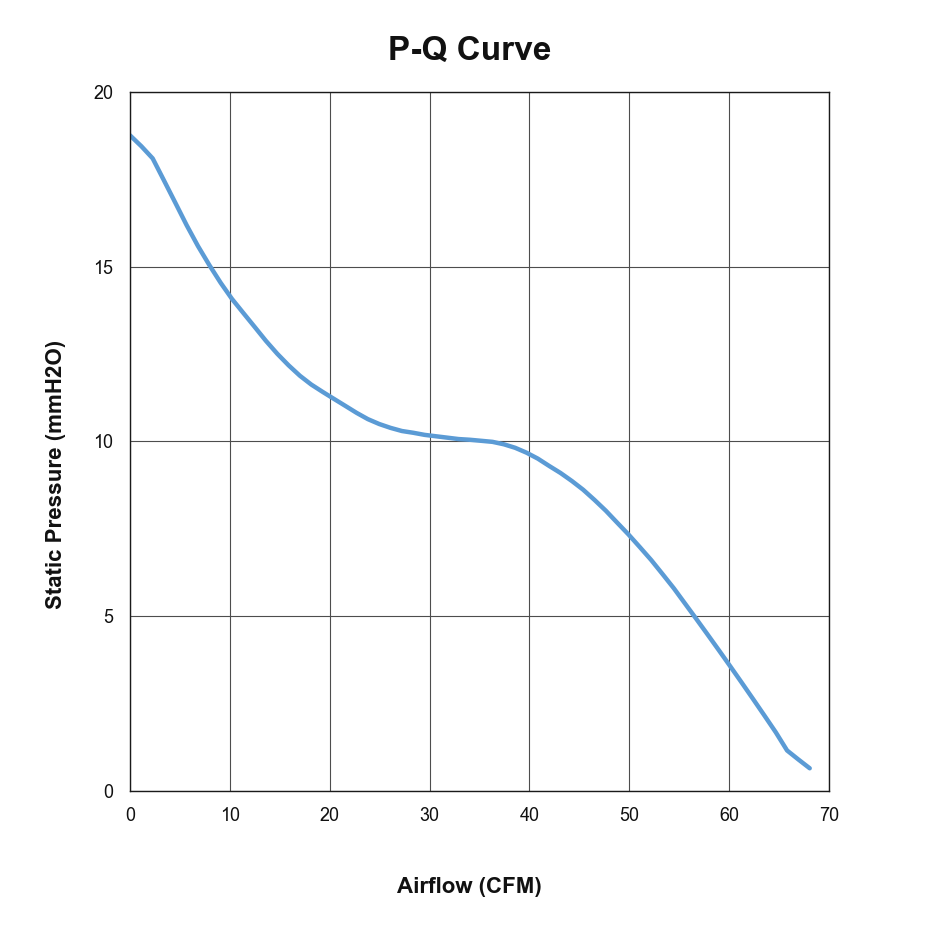
P-Q Curve — PCG74FZW76-38G-AK @ 48V DC
At nominal input conditions, this reference curve maps static pressure from 0-18.8 mmH2O against airflow from 0-68.1 CFM. Use it for first-pass operating-point review; full-resolution P-Q curves, CAD files, and product-specific datasheets are available for qualified RFQ review.
Avionics Cooling Fans for 28VDC Aerospace Electronics
Perseus avionics cooling fans and compact 28VDC axial fans are designed for aerospace electronics where SWaP constraints, environmental qualification, and electrical interface compatibility are critical. These fans support UAV electronics cooling, radar payload thermal management, airborne avionics bays, and mission computer enclosures operating from -55°C to +85°C.
BLDC fans with PWM speed control and FG/RD feedback signals are available for 28VDC power systems per MIL-STD-704. RTCA DO-160 considerations may apply for vibration, temperature, altitude, and EMI qualification categories. High-altitude applications above 50,000 ft require density-corrected airflow analysis, because reduced air density lowers both the cooling capacity per unit volume and the fan's pressure performance.
Avionics cooling fans for airborne electronics must balance airflow, static pressure, SWaP constraints, and environmental qualification. Common requirements include 28VDC operation per MIL-STD-704, PWM speed control with FG/RD feedback, and compliance with MIL-STD-810H for vibration, shock, and altitude.
Military DC Fan Selection FAQ
Answers to the questions engineers ask most when specifying DC axial fans for defense and aerospace enclosures.
What airflow (CFM) and static pressure do I need?
Estimate system heat load (watts) and allowable temperature rise, then calculate required airflow. For dense or ducted enclosures, static pressure matters as much as CFM — use a fan curve that still delivers airflow at your system impedance.
Can the fan survive -55°C to +85°C and high altitude?
Cooling performance derates with air density, so a fan specified for sea level may underperform at altitude. Confirm operating and survival extremes match your environment, and verify reliable cold-start behavior at the low end.
Do I need PWM speed control or tach feedback?
If the system adjusts cooling based on temperature, a PWM-controlled fan with a tachometer (FG) output gives closed-loop control and health monitoring. For fixed cooling, a low-cost constant-speed fan may be enough.
Engineering Resources
Technical guides to support your fan selection and system integration.
How to Read P-Q Curves for Military Fan Selection
Understand static pressure, airflow operating points, and system impedance for defense cooling applications.
Military Cooling Fan Selection Guide
Selection criteria for military cooling fans including environmental standards and qualification requirements.
28VDC Avionics Cooling Fan Evaluation
Evaluation framework for 28VDC avionics fans covering startup current, airflow, and EMI considerations.
Technical Insights
Engineering insights on thermal management, fan selection, and defense electronics cooling.