

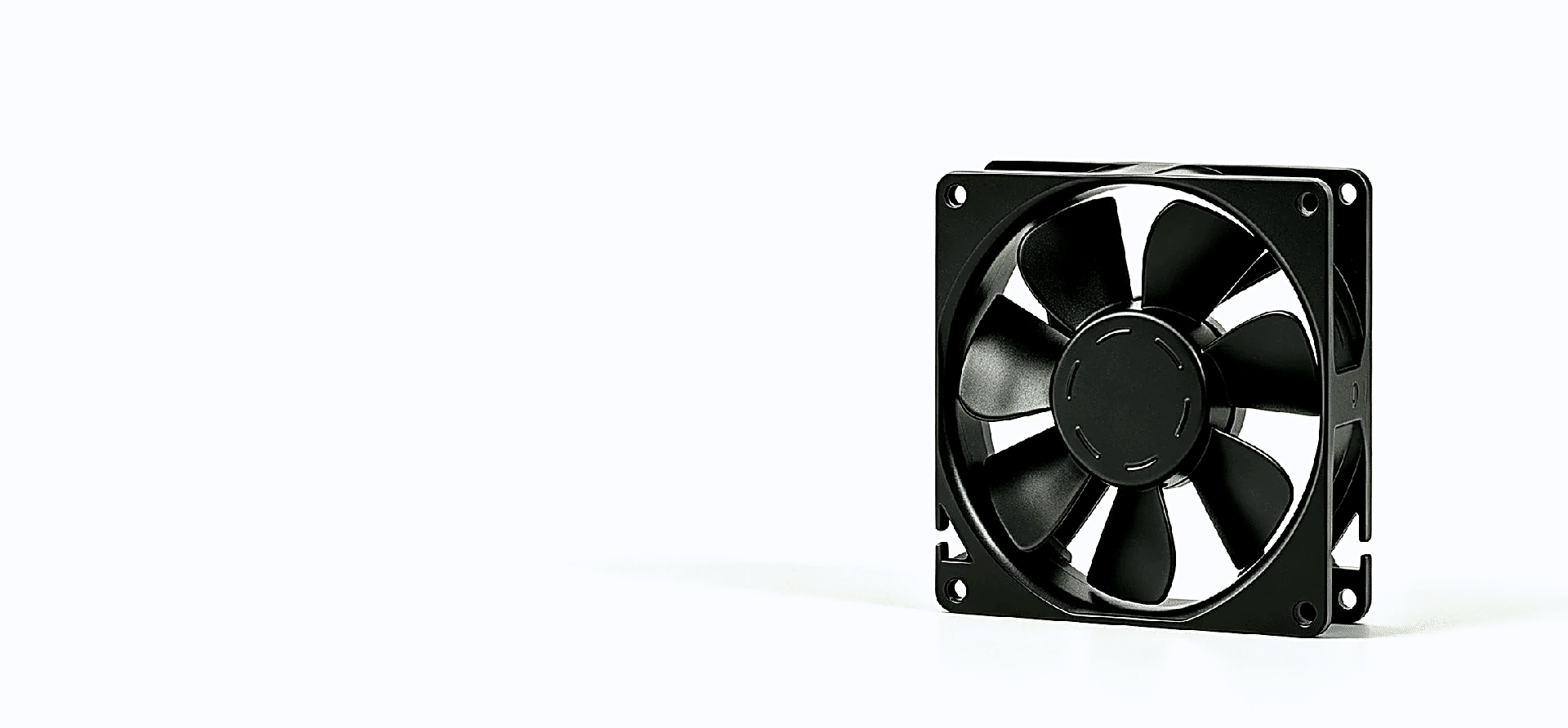
Heavy-Duty High-Capacity DC Fans for Defense Applications
High-airflow DC fans for radar bays, avionics enclosures, and military power supplies.
Perseus large DC fans are built for sustained duty in radar cabinets, power electronics, and sealed shelters. Oversized blade geometry, die-cast aluminum housings, and dual ball bearings are specified so the fan keeps its rated performance after 40G shock, dust loading, 18 months of salt-fog exposure, and continuous high-temperature operation — where replacement means taking the platform offline.
High-airflow DC fans for radar bays, avionics enclosures, and military power supplies.
Perseus large DC fans are built for sustained duty in radar cabinets, power electronics, and sealed shelters. Oversized blade geometry, die-cast aluminum housings, and dual ball bearings are specified so the fan keeps its rated performance after 40G shock, dust loading, 18 months of salt-fog exposure, and continuous high-temperature operation — where replacement means taking the platform offline.
Core Technical Features
High-Capacity Airflow Output:
Oversized blade geometry moves up to 892.65 CFM — enough for large power conversion systems and ground radar transmitters where smaller fans cannot shift sufficient air mass.
Depot-Level Structural Durability:
Die-cast aluminum housings resist deformation under shock loads that crack polymer frames. Dual ball bearings extend MTBF at continuous high-temperature operation.
Real-Time Health Telemetry:
Tachometer feedback, PWM speed control, and fault alarm outputs give integrators fan health data — so bearing degradation is caught before it becomes a mission abort.
MIL-STD-810H Qualification Planning:
Designed for model-specific review of extreme temperature, mechanical shock, rain ingress, and acidic atmosphere. The Archpro series adds 192-hour acidic salt spray resistance.
Typical Applications
-
![Avionics Bay Cooling Systems]()
Maritime patrol and transport aircraft carry several high-power assemblies in one bay. Megapro and Hyperpro deliver the airflow volume to hold bay temperatures across long-duration missions.
Avionics Bay Cooling Systems
-
![Ground-Based Radar Transmission Systems]()
High-power transmitters run continuously in fixed and mobile installations. The Archpro series sustains that airflow demand in desert environments above +55°C ambient.
Ground-Based Radar Transmission Systems
-
![Large Military Power Supply Modules]()
Vehicle-mounted and shelter-based power conversion needs stable cooling under random vibration. Megapro's tracked-vehicle vibration review addresses that failure mode directly.
Large Military Power Supply Modules
-
![Mobile Electronic Shelter Ventilation]()
Forward-deployed command and communications shelters need ventilation that survives transport shock and runs continuously, without relying on external HVAC infrastructure.
Mobile Electronic Shelter Ventilation


Series Selection Guide
Three series cover 92 mm and above with no gaps — place a model by its outer frame size: 92–110 mm Megapro, 111–150 mm Hyperpro, ≥151 mm Archpro.
| Series | Frame Size | Max Airflow (CFM) | Weight Range (g) |
|---|---|---|---|
| Megapro | 92–110 mm | 301.00 | 110–1750g |
| Hyperpro | 111–150 mm | 342.00 | 165–505g |
| Archpro | ≥ 151 mm | 994.00 | 420–4500g |
Compare Models
Narrow by frame size and supply voltage, then click any model to open its full technical page.
| Model | Frame | Airflow CFM | Static pres. mmH2O | Voltage | Noise dB(A) |
|---|
All Large DC Fan Models
7 models
- Megapro PCG85FZW48-25G-AG 92 mm x 92 mm x 25.4 mm 24 V DC 107.15 CFM
- Megapro PCG85FZW516-83G-AB 95.2 mm x 95.2 mm x 79.5 mm 28 V DC 301 CFM
- Megapro PCG91FZW511-127G-AA Dia. 97.5 mm x 127 mm 28 V DC 235.15 CFM
- Hyperpro PCG112FZW56-38G-AG 119 mm x 119 mm x 38 mm 28 V DC 195.5 CFM
- Hyperpro PCG112FZW53-38G-AC 119.2 mm x 119.2 mm x 38 mm 28 V DC 125.3 CFM
- Archpro PCG148FZW57-51G-AF Dia. 171.5 mm x 50.8 mm 28 V DC 387 CFM
- Archpro PCG195FZW56-121G-AA Dia. 239.5 mm x 121.4 mm 28 V DC 994 CFM
Model Reference
Below are representative models — one per series — illustrating key performance parameters and environmental adaptabilities.
Each PQ curve shows measured static pressure vs. airflow at rated voltage.


Core Electrical & Performance Parameters
| Parameter | Specification |
|---|---|
| Rated Voltage | 24V DC |
| Voltage Range | 18-26.5V DC |
| Rated Rotational Speed | 8,300 RPM |
| Max Airflow | 107.15 CFM |
| Max Static Pressure | 31.27 mmH2O |
| Acoustic Noise | 62.6 dB(A) |
| Speed Control Mode | PWM |
Mechanical & Environmental Parameters
| Parameter | Specification |
|---|---|
| Frame Size | 92mm x 92mm x 25.4mm |
| Protection Rating | IP67 configuration option |
| Operating Temperature Range | -55°C to +85°C |
P-Q Curve — PCG85FZW48-25G-AG @ 24V DC
At nominal input conditions, this reference curve maps static pressure from 0-28.8 mmH2O against airflow from 0-107.2 CFM. Use it for first-pass operating-point review; full-resolution P-Q curves, CAD files, and product-specific datasheets are available for qualified RFQ review.

Core Electrical & Performance Parameters
| Parameter | Specification |
|---|---|
| Rated Voltage | 28V DC |
| Voltage Range | 18-32V DC |
| Rated Rotational Speed | 6,800 RPM |
| Max Airflow | 195.5 CFM |
| Max Static Pressure | 43.8 mmH2O |
| Acoustic Noise | 71.9 dB(A) |
| Speed Control Mode | PWM |
Mechanical & Environmental Parameters
| Parameter | Specification |
|---|---|
| Frame Size | 119mm x 119mm x 38mm |
| Protection Rating | IP55 configuration option |
| Operating Temperature Range | -40°C to +70°C |
P-Q Curve — PCG112FZW56-38G-AG @ 28V DC
At nominal input conditions, this reference curve maps static pressure from 0-42.8 mmH2O against airflow from 0-195.6 CFM. Use it for first-pass operating-point review; full-resolution P-Q curves, CAD files, and product-specific datasheets are available for qualified RFQ review.

Core Electrical & Performance Parameters
| Parameter | Specification |
|---|---|
| Rated Voltage | 28V DC |
| Voltage Range | 18-32V DC |
| Rated Rotational Speed | 7,000 RPM |
| Max Airflow | 387 CFM |
| Max Static Pressure | 62.48 mmH2O |
| Acoustic Noise | 72 dB(A) |
Mechanical & Environmental Parameters
| Parameter | Specification |
|---|---|
| Frame Size | Dia. 171.5mm x 50.8mm |
| Protection Rating | IP67 configuration option |
P-Q Curve — PCG148FZW57-51G-AF @ 28V DC
At nominal input conditions, this reference curve maps static pressure from 0-68.6 mmH2O against airflow from 0-430.9 CFM. Use it for first-pass operating-point review; full-resolution P-Q curves, CAD files, and product-specific datasheets are available for qualified RFQ review.
Heavy-Duty DC Fans for Radar & Power Electronics
Perseus large DC cooling fans are engineered for high-airflow thermal management in radar cabinets, power electronics, rugged shelters, and high-density electronics chassis where operating-point airflow matters more than free-air airflow. These units deliver sustained static pressure for defense ground platforms, shipboard electronics bays, and military power supply modules operating in harsh environments.
BLDC fans with PWM speed control and FG/RD feedback signals are available for 12V, 24V, and 28VDC power systems. Fan selection should account for static pressure requirements, power-bus limits, startup current, acoustic targets, and available inlet/outlet clearance. MIL-STD-810H environmental qualification planning is supported for applicable configurations.
Large DC cooling fans can draw short-duration startup or peak currents above their rated average current. Power supplies should be reviewed for transient current capability as well as steady-state current, especially when multiple fans start at the same time on a shared DC bus.
For high-density enclosures, selecting a fan based solely on free-air CFM can lead to insufficient cooling when static pressure losses from filters, ducts, and heat sinks are present, so installed airflow should be validated using system impedance calculations.
Engineering Resources
Technical guides to support your fan selection and system integration.
How to Read P-Q Curves for Military Fan Selection
Understand static pressure, airflow operating points, and system impedance for defense cooling applications.
Military Cooling Fan Selection Guide
Selection criteria for military cooling fans including environmental standards and qualification requirements.
28VDC Avionics Cooling Fan Evaluation
Evaluation framework for 28VDC avionics fans covering startup current, airflow, and EMI considerations.
Technical Insights
Engineering insights on thermal management, fan selection, and defense electronics cooling.